Bubbles gives the same aiming problem two different goals. In Classic, a large drop can be worth more than a quick clear. In Fewest Shots, clearing the board in fewer shots is the point. That changes which move is worth taking.
Start with one decision.
Bubbles is a browser bubble shooter. Aim, match three or more, and remove the bubbles holding the rest of the board up. The pleasure is in seeing an angle become an opening: a useful match can bring down more than the cluster you hit. You can play with a pointer or on a phone, without installing it.
Fewest Shots takes that familiar action and gives it a clear finish. There is one board and no shot limit. A slow clear still counts. Stopping after a few shots does not produce a better record than finishing; only a successful clear sets one.
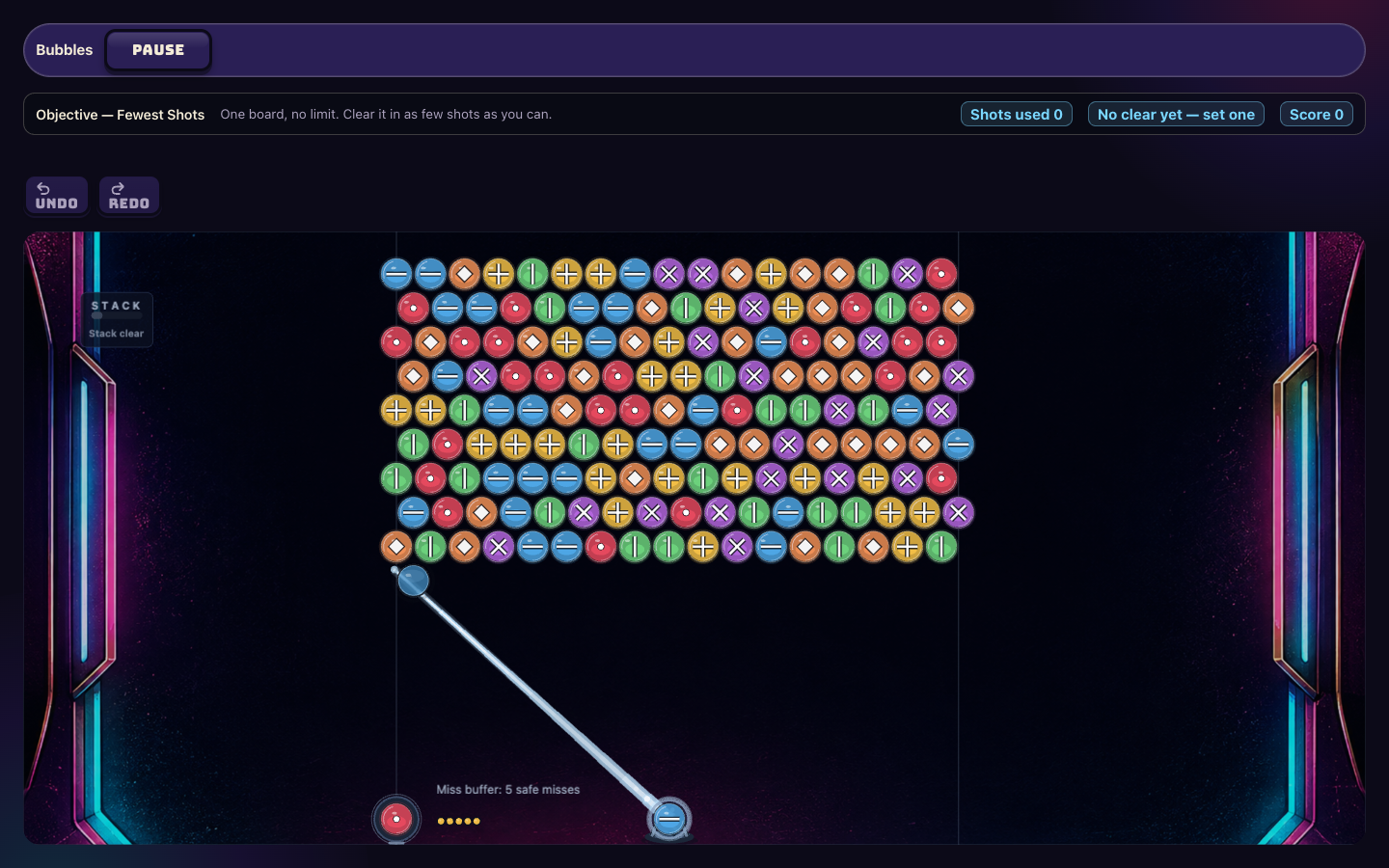
The goal changes the shot.
Classic’s own mode description warns that big drops can outscore a quick clear. That is a reason to keep building towards a larger drop. Fewest Shots asks a different question of the same board: can you remove what is holding it up without spending as many shots?
A spectacular score and an efficient clear are different accomplishments. Putting the shot count beside the board makes the second one visible while you play. The starting screen says “No clear yet — set one”. It gives the first player a useful target without pretending they have already beaten anyone.
There is a cost to that focus. If you like a rising score, a tight clock or a string of different goals, this may not be your round. Choose mode also offers Classic, Practice, Time Attack and puzzles. An efficiency challenge earns its place by making one objective legible, not by replacing every other kind of play.
Make the next attempt specific.
For a first visit, aim for a clear. On the next attempt, pay attention to shots that only add bubbles and shots that remove the support above a larger group. That is a practical way to look for improvement; it is not a guaranteed solution or a claim that every board takes the same number of shots.
Read the scope beside a record. The catalogue can show a personal best across boards; that is different from improving a result on the same board. A local best, a submitted result and a global board have different meanings. Woodhouse’s aggregate completed-run count answers another question again: it does not tell you how efficiently someone cleared this challenge.
The game can therefore give you something worthwhile before there is a crowd to race. Learn the board, finish it, and decide whether you can see a shot you would change. That is enough of a reason for another round.
Source and review
Bubbles’ public Choose mode and Fewest Shots play screens, opened on 23 October 2026; its published Classic and challenge rules and existing reviewed game record. The illustration is a fresh public-game capture before a shot, not a submitted result. No player, score or audience achievement is asserted. The publication does not reproduce private repository bodies or conversation transcripts.