Good ideas.
Shared parts.

Make something with this.Try a working connection, then take the useful part into your own game or app.

Open the patch bench ↗

Explore the connected portfolio ↗

One working system, taken apart.

The first working example on this site is not a screenshot. Open the bench and you get the game, its sound effects and a real LoftwahFM station, wired the way a game actually wires them — then separated so you can see who owns what.

02

Effects

The sound the game owns

Effects bus

Generated in the browser with oscillators, on a bus of the game’s own. Muting it never touches the soundtrack.

Owner
The game
Source
Local oscillators
Breaks with
The browser only

The game’s effects are its own. They are generated on the spot, they answer to the game’s mute, and they would keep working with the music service completely unreachable.
01

The run

A small game that routes signals

0 pointsstreak 0●●●

The run is a real game with a real score. It owns its scene, its rules and its effects. It never asks the music service for permission to exist.

03

Music

Streamed from LoftwahFM

No track yet

idle

Music bus

Preparing the station…

Owner
LoftwahFM
Transport
One media element
Breaks with
The network only

A real public LoftwahFM station, played through the supported client. Pull the link and the soundtrack stops while the run carries on.

Woodhouse working exhibit

The patch bench

A game, the sounds it owns, and a soundtrack streamed from somewhere else. Open the bench, then take it apart.

Pull to take it apart

Three layers, one working system

The run, its effects and the soundtrack are three separate owners. The bench shows what happens when you pull them apart: the game keeps its score, the effects keep their own sound, and the music stops and starts without either of them noticing.

Open the full bench Get the integration recipe

A soundtrack can travel from a music service into a game. A photo can travel from a guestbook into a creator’s collection. Woodhouse brings those connections together so you can try them, understand them and use the useful parts in your own work.

Give your game a soundtrack.

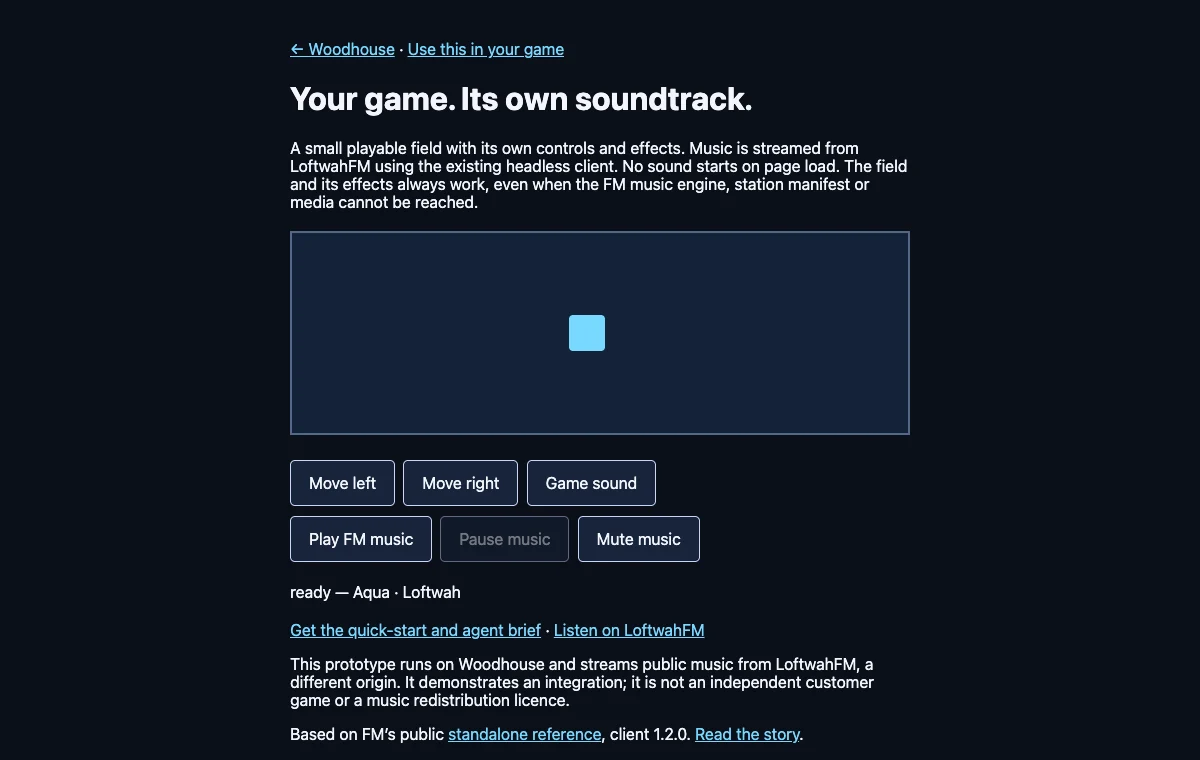
Move the player, trigger a sound effect, then turn on a LoftwahFM station. The game runs here; the music comes from FM. Turning music off leaves the game and its effects working.

For browser-game builders, the useful part is the player you don’t have to write: a versioned client, public stations and a short integration recipe.

The small playable field with separate game sound and FM music controls.
FM / A game here, a soundtrack from LoftwahFM. Captured 18 October 2026.
Take the bench apart ↗Use it in your game ↗Read the story ↗Try the plain standalone demo ↗

A streaming prototype with public music. It demonstrates the connection, without claiming a customer adoption or redistribution rights.

A portfolio with a guestbook of its own.

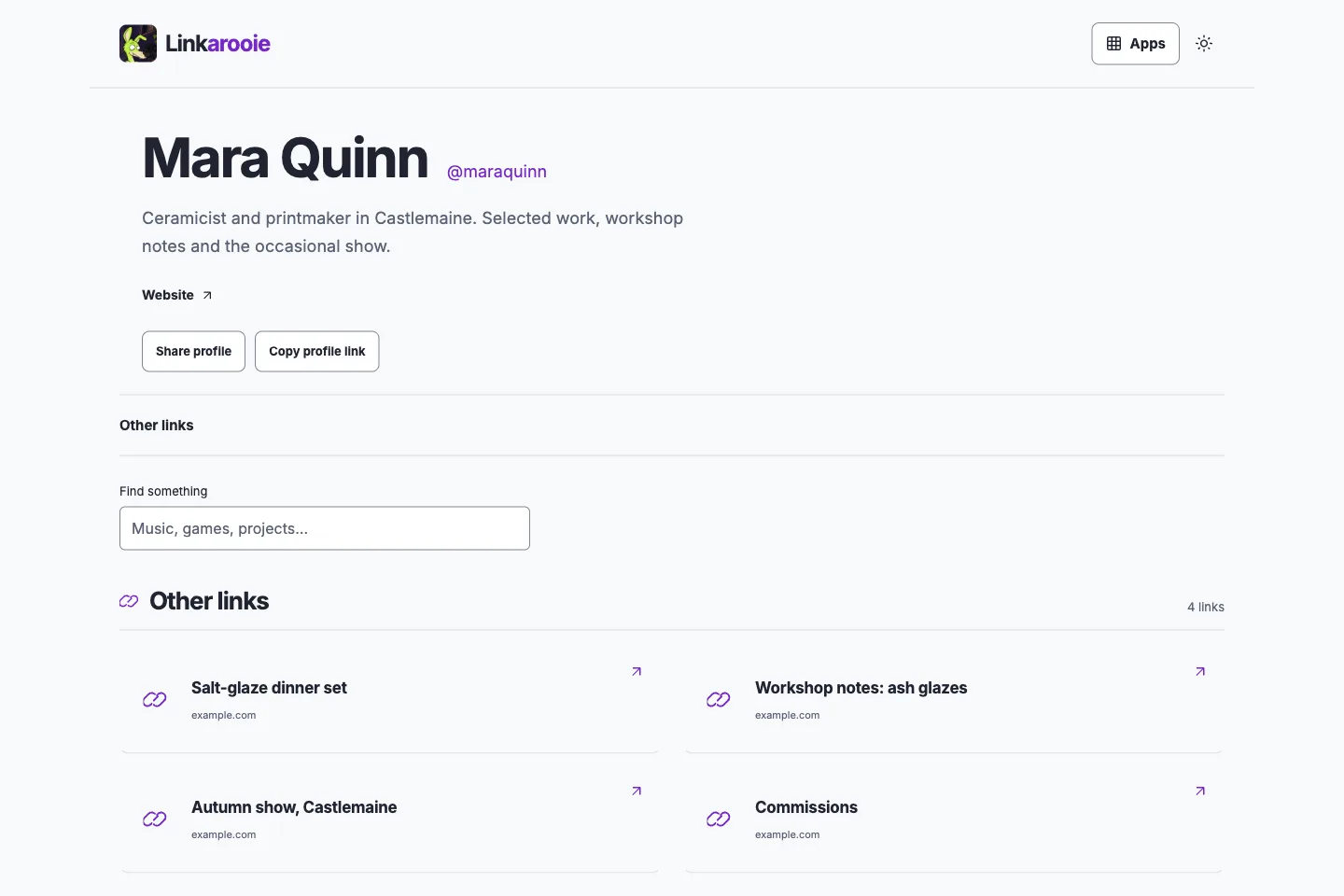
Mara Quinn has a portfolio for her ceramics and a guestbook for visitors’ postcards. Postcards wait for approval in Here / there. Linkarooie can feature an approved one and removes it from the portfolio when the owner hides the original.

The two apps come from one Composer brief. Each has its own source repository, address and database. Open them to see what visitors see, or use the same starting point in Init to give your agent a brief.

Mara is fictional. The reference apps run in the operator’s Cloudflare account. A first-time creator’s own-account build is still to be demonstrated.

One human directs the work.

Dean chooses what to make and checks the result. Coding agents carry out bounded work across the projects. Each product keeps its own identity, source and releases.

The human operator sets intent and authority; software agents do bounded work; qualification reviews the exact state; production proves the deployed behavior; real use returns evidence to the operator.
From human intent to evidenceTests, release and real-world use are different observations. The loop only closes when evidence returns to the operator.View the system model (D2)
Read the diagram in text
  1. Human operatorSets intent, boundaries and ownership.
  2. Software agentsComplete bounded work that stays reviewable.
  3. QualificationChecks the exact candidate and records what passed.
  4. ProductionDeploys a named state and observes live behavior.
  5. Real usePeople, devices and environments add evidence that software checks cannot supply.
Music integration versions and game adoption records

LoftwahFM. Sound for the long session.

Music and original radio for the long session. Listen here, open a presenter show, or discover the games using LoftwahFM. Press Play to start.

Listen here

Press Play in the player. Closing this panel stops playback. Open this station on FM.

Original shows

Original satire with synthetic presenters and explicit language. Reviewed 13 October 2026. Publication evidence.

Follow the shared client and game adoption evidence

Radio attribution and native sharing.

LoftwahFM owns catalogue, radio generation, programming, audio publication and client releases. Each game owns playback transport, preferences, gameplay cues, mobile lifecycle and deployment. Woodhouse publishes reviewed relationships and evidence.

LoftwahFM dossier · Capability review · Upstream evidence

For game developers · client 1.2.0

Public quick-start and copyable agent brief · Try music in the independent-origin demo

Available upstream: @loftwahfm/radio-client@1.2.0. manifest schema 1 / client major 1.

Reviewed supported pins: 1.0.0 · 1.1.0 · 1.2.0. Each game’s installed version is recorded below.

See 5 consumer adoption records
  • SHOALSHOT

    The dedicated radio stages retain their 11 October source/release/full playback receipts at 365fcf0. The 13 October dossier separately records later finished-dive sharing and Home menu repair; that later menu interaction is not a fresh full radio replay. SDK 1.2.0 remains installed; physical phone/human listening and continuous shared My Mix remain separate. Station: Listen to Low Tide.

    Browser evidence reviewed · Adoption evidence · Owning integration issue

  • Fighter

    SDK 1.2.0 now reports listening from native progress and actual host output through the existing audio manager. All eight stations and saved shuffle remain. A naturally finished fight offers a branded PNG, download and caption, labelled as a local unverified result. The live page names the same revision as the owning exact-main release. The distinct-game foundation remains proposed. Woodhouse reviewed source and the owning receipts; it did not repeat game playback. Physical phone, human listening and native OS sharing remain separate acceptance. The reviewed browser receipts use excluded test attribution. They prove scoped behaviour, not real audience listening, score verification or a completed variant platform. Station: Listen to Pressure System.

    Browser evidence reviewed · Adoption evidence · Owning integration issue

  • Protocol 11

    The original Jukebox and SDK 1.0.0 radio stages retain their 11 October evidence. The 13 October dossier separately records later player journeys and result sharing; no newer radio-client or audible-attribution verification is claimed. Station: Listen to Cartridge Club.

    Browser evidence reviewed · Adoption evidence · Owning integration issue

  • Bubbles

    SDK 1.2.0 audible-progress attribution is established by the dedicated 12 October source/release/full player receipts at 64c1a60d. Later Classic sharing at 60e4e696 has its own 13 October status and receipt; it does not replace that full radio proof. Owner-preview, held editorial/shared mix, formal qualification, physical phone and human listening limits remain. Station: Listen to Soft Focus.

    Browser evidence reviewed · Adoption evidence · Owning integration issue

  • Pirates

    Optional Enhanced radio remains planned. Original stays the default offline game; no adapter or hosted adoption is established. Station: Listen to Saltwater Static.

    Planned · Adoption evidence · Owning integration issue

Fighter, Bubbles and SHOALSHOT now install the reviewed 1.2.0 client. Their latest source/release receipts are recorded separately from earlier full radio journeys. Protocol 11 retains its dated 1.0.0 radio evidence; its new gameplay release is not a new attribution receipt. Pirates remains planned. Physical devices, human listening, formal owner-preview limits, continuous shared My Mix and actual audience use remain separate.

Looking for something to play, hear or try? Explore all 12 project records. For the implementation, follow the architecture or thestories behind the work.

Public examples checked 18 October 2026. Detailed product states keep their own review dates. Private repositories and conversations are not reproduced here.